Canon RF 20-50mm F4 L IS USM PZ MTF Analysis: Optically Great or Overhyped?
I've seen some attempts at the MTF review of this lens, which left me puzzled, so in order to make this a little clearer to our readers, I decided to create a separate article from our announcement detailing the MTF.
While I'm not one to accuse other sites of deliberately misleading their viewership, I do find it unethical to incorrectly portray data and then attempt to get commissions based on that information. Yes, I'll have a preorder link myself, but I'll also tell you what I think is wrong or not great with this lens, and tell you how I'd fix it, then leave it up to you if it's worth the hassle for $1399.
About Canon's MTF diagrams
First and foremost, when reading Canon's MTF, the 10lp/mm is used to determine how contrasty the lens is and the expectation of contrast throughout the frame. If contrast tails off into the corners, it's more difficult for auto focus and also for corrections to recover what detail you can in the corners.
The blue lines are 30lp/mm, which are used to determine the resolution or how sharp the lens is.
The solid lines (of either black or blue) are the sagittal lines, which means the MTF was measured parallel to the radius of the frame. The dotted lines are Tangential/Meridional, which are the measured lines perpendicular to the radius of the frame. How close these follow each other tells us how much astigmatism and also the bokeh quality of the lens.
If the blue solid and dotted lines are mostly parallel to each other to the outer limits of the frame, the bokeh quality should be good, and the astigmatism should be low. If they wildly diverge, we'll have subpar bokeh and perhaps quite a bit of smearing in the corners.
Canon RF 20-50mm F/4L IS USM PZ MTF
The MTF diagram of the Canon RF 20-50mm F/4L IS USM PZ is shown below.
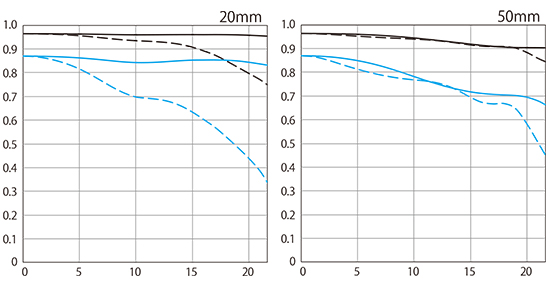
This lens is slightly better MTF-wise than the RF24-50mm F4.5-6.3 IS STM. So if you were curious about the performance of the Canon RF 20-50, then that would be your first place to compare.
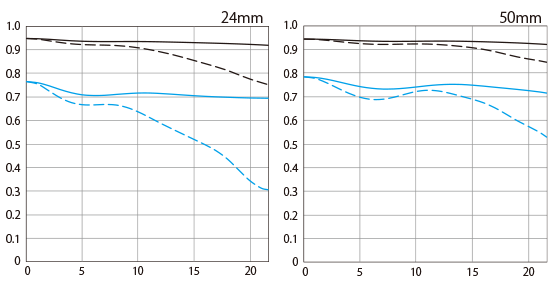
Now, to be fair, the Canon RF 24-50mm starts at 24mm and not at 20mm, but the MTF diagrams between these two lenses are eerily similar otherwise. So with that in mind, if you like the output you see from the Canon RF 24-50mm but want a better quality lens (weathersealing and power zoom) and the most important - the ability to shoot at 20-24mm, then there's no question about it.
Canon made this lens for the video crowd as well, so they probably assumed that most of the main points of interest would be centered on the frame, and thus they didn't care as much about the corner performance as they would a primarily stills-based photography lens.
That all being said, the Canon RF 20-50mm shows the meridional resolution absolutely cratering at 20mm, which indicates that you'll see quite a bit of smearing and astigmatism wide open. Your best results will be to stop this lens down to reduce the astigmatism. Now at 20mm, this is probably not a problem if you are not using this for architecture and interior photography, where you need all the speed you can get from the lens. This lens certainly will have very limited use for astro landscapes because of the astigmatism.
As far as 50mm at the telephoto end, while it's good if you compare against Canon's other 50mm primes, those primes are also quite a bit faster, so if you stopped those primes down to F/4, they would be considerably better than their MTF would indicate. The performance at 50mm is certainly decent. Not great, but decent. Unlike the 20mm, it will have much better bokeh, which is usually what we want at 50mm, though at f/4 you won't get the subject separation as you would with a 50mm prime.
Would I purchase this lens?
Yes, not because it's an optically great lens (it's really not, and anyone who says that from the MTF doesn't know what they are looking at), but the fact that it's a 20-50mm lens that is very unique. For me, to get around the astigmatism at 20mm, I would use either JPG in camera with DLO turned on, or for RAW shooters - I'd process through Digital Photo Professional's (Canon's own software) DLO.
DLO will work with that lens to correct the astigmatism by applying a deconvoluted math transfer function to the image to extract as much detailed information as possible. It's not just sharpening - it's deconvolution-based math with Canon knowing the data of each lens and each camera. This is why DLO was developed, to work on thorny optical aberrations such as this.
Combine this lens with DLO, and you have a winner on your hands - without DLO, then it's up to you and what you shoot if it's worth the $1399. Just beware of the limitations wide open on the important ultra wide end.
Pre-Order the Canon RF 20-50mm f/4 L IS USM PZ Lens for $1399
51
blog comments powered by