This post may contain affiliate links(s). An affiliate link means I may earn advertising/referral fees if you make a purchase through my link,
without any additional cost to you. It helps to keep this site afloat. Thank you in advance for your support. If you like what we do here, maybe buy me a
coffee.
USM on the way out? Highly Unlikely
An amusing article crossed my path today (thanks!) about particular musings about VCM and USM. The author of the article assumed that because Canon hasn't released many ring-type USM lenses and was focusing on VCM, USM must be on the way out the door in terms of optical design at Canon. Even though this sounds like clickbait (it probably is), it is an interesting thought nonetheless. So I thought it would be a good idea to drill into this subject in a bit more technical depth.
It should be noted that most of Canon's VCM primes also have a Nano-USM motor as well as a VCM motor. Yes, most of them are dual motor, even though the lens simply states VCM. Perhaps, people not well-versed in Canon technology from a technical level may make this common error and assume that it simply has VCM motors because that's the name of the lens.
There are some distinct advantages that ring-type USM brings to Canon's lenses that VCM simply at this time would struggle to replace.
Higher Torque
There is a reason Canon uses ring-type USM on its super telephotos: with super telephotos, more than any other lens, there is a need for high torque and speed of movement. These lenses are longer, and at times, the groups have to move far more. Even though Canon has done a lot to minimize the size of these elements to maintain excellent image quality and low aberrations, they are still larger than those of a small prime. VCM excels in small, fast movements but doesn't have nearly as much torque for larger elements, such as what super telephotos will have.
High Holding Force with Zero Power
Many people complain about the "rattle" with the VCM lenses, as VCM motors do not hold the optical group while powered off, so if the lens is in your bag, or your camera is powered down, the optical group is free to shift around inside the lens.
Canon's L series lenses employ a physical image stabilization lock, so the small image stabilization group does not freely move inside their L series lenses when they are powered down. Shown below is an excellent illustration from exclusivearchitecture.
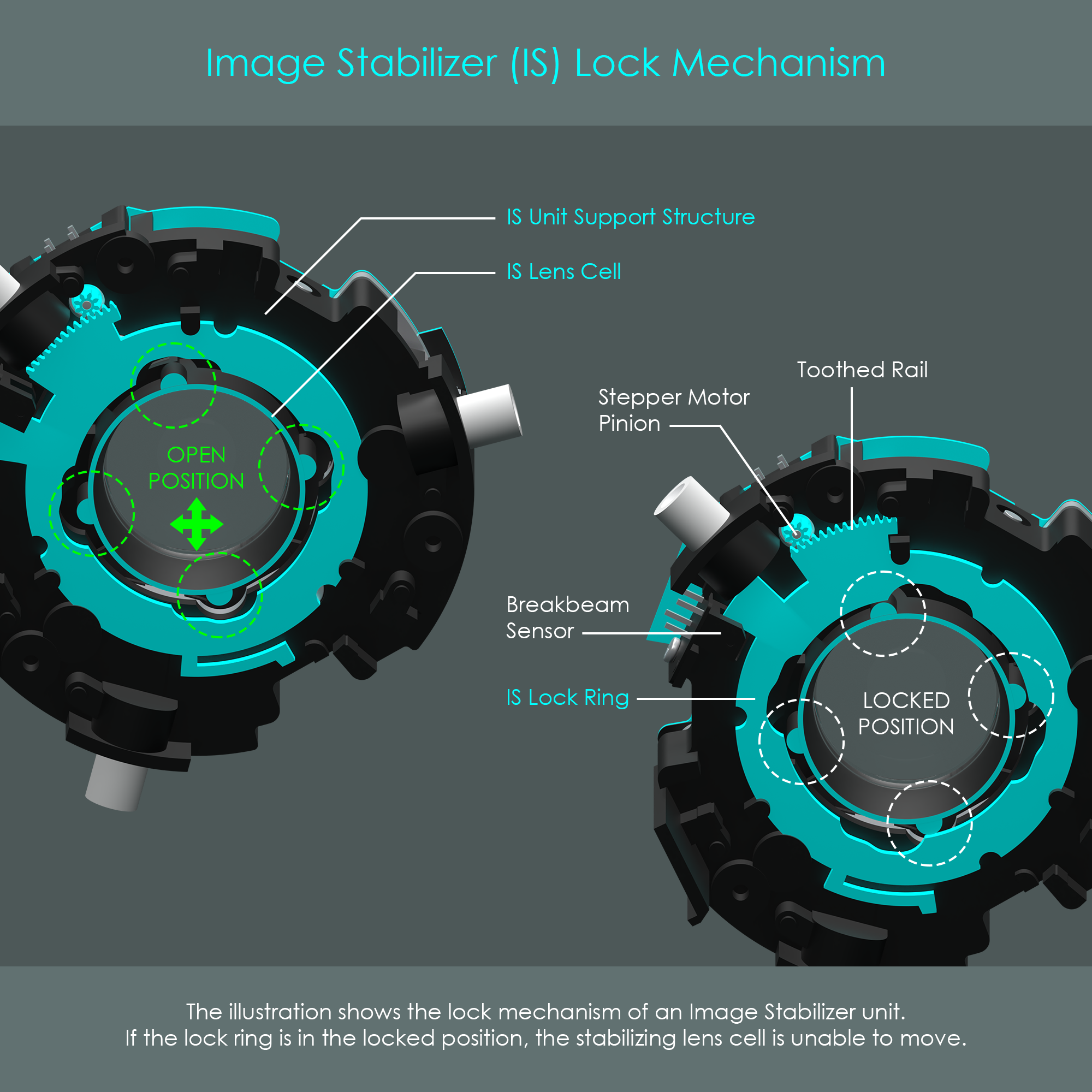
Canon goes through this trouble on its professional gear to ensure that elements don't shift around much during transport and while not in use, so I can't see them suddenly thinking that a larger optical group can suddenly move around at will as you are transporting your gear.
Rare Earths
I originally thought that perhaps more rare earth materials could be used in ring-type USM than in VCM, and that may be a reason why Canon leans towards VCM over USM; however, it turns out it's actually the reverse. VCM motors employ several stator magnets that are usually rare-earth magnets, while with ring type USM, rare earths are used as a doping material, and not as a dedicated magnet.
If supply chains get a little messed up when it comes to rare earth materials and, more importantly, rare earth material processing, then VCM motors may actually have a harder time with it.
Low Power Consumption
USM motors only consume power when you are moving the elements. If the lens is focused or the elements are parked stationary (for example, you aren't taking a photo that instant), then the lens motors consume no power. VCM, however, requires power to "hold" the optical elements in place; this means that the lens itself is continually drawing power when the camera is turned on, regardless of focusing.
This means that there is a continual "leakage" of power to keep those VCM motors actively energized to maintain the optical group's positioning, something that is completely unnecessary for ring-type USM.
While for smaller primes this may not be a problem, the problem compounds with larger motors and larger optical groups, as this will increase the draw of these motors and drain your battery faster. If you compound adverse weather that super telephotos are often used in (extreme cold, for example), all this compounds and aggravates an existing problem of battery drain even further.
Closing Thoughts
VCM motors are certainly useful, and OEMs such as Sony regularly use them in a multitude of lenses, including super telephotos. However, Canon's strength is picking the best technology for the specific lens and the use case. For the case of high torque and fast movement, not to mention the security of not having a lens rattle when powered off, Canon's ring-type USM does excel over that of VCM.
Will Canon get away from USM altogether? It's highly unlikely that ring-type or all forms of USM motors will disappear, even in Canon's latest technology VCM primes; nano-USM motors are still employed.
It should be noted that nano-USM is a rather new invention from Canon, coming out in the mid 2010's, so primes that still use ring-type USM would most likely adopt nano-USM motors, while I could see the super telephotos sticking it out with USM.

Richard @ CanonNews
Richard has been using Canon cameras since the 1990s, with his first being the now legendary EOS-3. Since then, Richard has continued to use Canon cameras and now focuses mostly on infrared photography. Richard is the founder and editor of CanonNews since 2017, and has worked as a writer on CanonRumors and other websites in the past.
Other posts by Richard @ CanonNews
Contact author
blog comments powered by