This post may contain affiliate links(s). An affiliate link means I may earn advertising/referral fees if you make a purchase through my link,
without any additional cost to you. It helps to keep this site afloat. Thank you in advance for your support. If you like what we do here, maybe buy me a
coffee.
Venus Optics Unveils World-First 17mm f/4 Tilt-Shift & Shift-Only Lens Duo
Laowa has announced a new ultra-wide prime lens and gave it two different flavors, which I do believe is a first for the industry. The Laowa 17mm f/4 Zero-D Tilt-Shift / Shift lens comes in two different varieties, one with full tilt and shift movements and the other with just shift movements.
While we Canon users have been patiently waiting for native RF-mount TS-E lenses to be rolled out on the roadmap, Venus Optics has filled this gap with the announcement of the Laowa 17mm f/4 Zero-D Tilt-Shift lens. This is quite a specialized lens, with a sophisticated design. Venus Optics (Laowa) has previously worked in the tilt-shift space and has built up a portfolio of tilt-shift lenses, as well as its Zero-D minimum-distortion lenses. For Canon users, this offers a native RF-mount lens as an alternative to the legendary but aging EF 17mm f/4L Tilt-Shift USM.
The lens features Laowa’s "Zero-D" (Zero Distortion) optical design. Delivering an ultra-wide 113° angle of view on full-frame sensors with perfectly straight lines is quite an achievement. This lens is intended as a first choice for photographers who need to keep lines perfectly straight. The lens is being released in two versions, one as a Shift-only version priced at $999 and another as a Tilt-Shift version priced at $1,249. The Tilt-Shift version offers +/- 12mm of shift and +/- 10 degrees of tilt, and the Shift version offers +/- 11mm of shift.
Construction and MTF
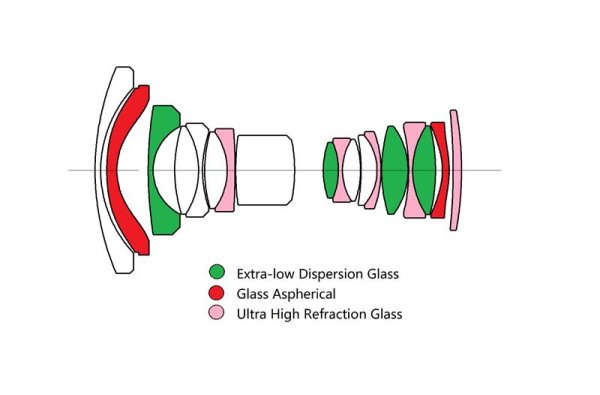
The optics of this lens are impressive, with 18 total elements across 12 groups. There are 2 aspherical elements and 4 extra low dispersion glass elements, as well as 4 extra high refraction glass elements.
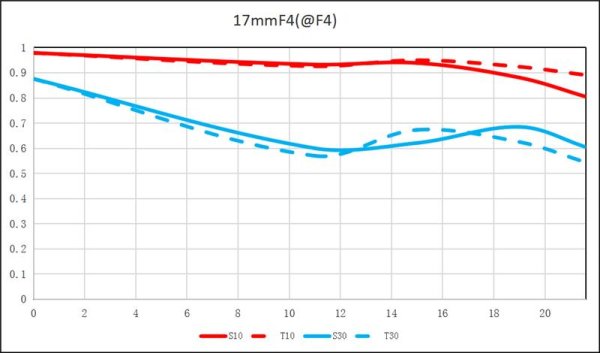
The MTF for the lens looks good; however, like most tilt-shift lenses, they aren't show the MTF once you get past the normal image circle of full frame to show how well the lens works when it's fully shifted. So we'll have to wait for independent tests to see how well it does in the corners shifted. However, since it's not falling off into the corners unshifted, we can guess that it's at a minimum decent unless it falls off a cliff in terms of resolution
Specifications
| Principal specifications |
| Lens type |
Prime lens |
| Max Format size |
Medium Format (44x33mm) |
| Focal length |
17 mm |
| Image stabilization |
No |
| Lens mount |
Canon RF, Canon RF-S, Fujifilm G, Hasselblad X, L-Mount, Nikon Z, Sony E, Sony FE |
| Aperture |
| Maximum aperture |
F4 |
| Minimum aperture |
F22 |
| Aperture ring |
Yes |
| Number of diaphragm blades |
14 |
| Optics |
| Elements |
18 |
| Groups |
12 |
| Special elements / coatings |
4 extra-low dispersion, 2 asph., 5 ultra high refraction |
| Focus |
| Minimum focus |
0.25 m (9.84″) |
| Maximum magnification |
0.13× |
| Autofocus |
No |
| Full time manual |
Yes |
| Focus method |
Internal |
| Distance scale |
Yes |
| DoF scale |
Yes |
| Physical |
| Weight |
810 g (1.79 lb) |
| Diameter |
93 mm (3.66″) |
| Length |
111 mm (4.37″) |
| Colour |
Black |
| Filter thread |
86 mm |
| Hood supplied |
Yes |
| Tripod collar |
Yes |
Image Gallery

Richard @ CanonNews
Richard has been using Canon cameras since the 1990s, with his first being the now legendary EOS-3. Since then, Richard has continued to use Canon cameras and now focuses mostly on infrared photography. Richard is the founder and editor of CanonNews since 2017, and has worked as a writer on CanonRumors and other websites in the past.
Other posts by Richard @ CanonNews
Contact author